
This is the first of a running series we're writing specifically about schools, because the more time we've spent with them the more convinced we've become that they carry a communication burden almost no other kind of organization does, and that hardly anyone names it out loud. A business mostly talks to customers. A school talks to everyone, at once, all the time, to the parents and the students and the staff and the prospective families and the alumni and the wider community, each of whom has different questions and different anxieties and a different sense of how quickly they deserve an answer, and the poor front office is somehow supposed to be the single switchboard for all of it.
We want to spend this whole series thinking honestly about that load and what can actually be done about it, and we should say plainly from the start that we build AI communication tools for a living, so you should read everything here knowing we have a stake in it. But the burden itself is real whether or not anyone ever buys anything from us, and we think it's worth describing carefully, because a problem that goes unnamed tends to get blamed on the people struggling under it rather than on the structure that's crushing them, and school staff get blamed for this constantly and unfairly.
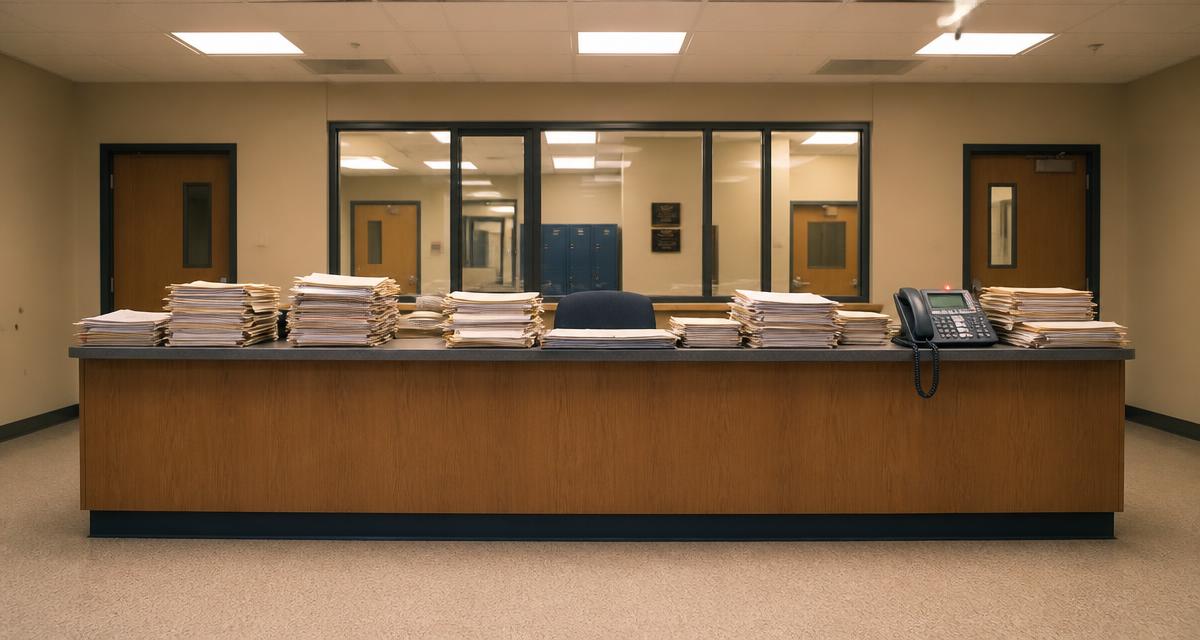
Picture the front office of an ordinary school on an ordinary morning, because the specifics matter. The phone is ringing with a parent asking about the bus that didn't come. A second line is a family calling to report their kid home sick. Someone is standing at the counter needing a form. An email just came in from a prospective parent who found the school online last night and is deciding between three options. A teacher needs something. The attendance system needs updating. And every one of those things feels urgent to the person on the other end of it, and there is one human, maybe two, expected to hold all of it at once, which is not a workload, it's a small daily impossibility.
The thing that makes school communication uniquely brutal, compared to a business, is that so much of it is emotionally loaded in a way a normal customer question isn't. A parent isn't asking about a product, they're asking about their child, which means even the routine questions carry a charge, and a slow or fumbled answer doesn't just annoy them, it makes them anxious about whether their kid is safe and known and cared for. That emotional weight is part of why the load is so exhausting to carry, because you can't handle it mechanically, every interaction asks for a little bit of real human attention, and there simply isn't enough of it to go around.
Then there's the coverage problem, which is the same one that quietly wrecks a lot of organizations but hits schools especially hard. Families live their lives on their own schedule, which means the questions arrive in the evening after work, on the weekend, over the summer, during the long breaks, at all the exact times the office is dark. A prospective family researching schools does it at nine at night when their own kids are finally asleep. In the enrollment world specifically, researchers have pointed out that a typical admissions or front office covers something like forty of the week's hundred and sixty-eight hours, which means the great majority of the time an inquiry arrives, there is nobody there to catch it, and it waits, and waiting is where families drift.
We keep coming back to a particular kind of loss that this creates, the loss that leaves no trace, because it's the one that never shows up in any report and therefore never gets fixed. The prospective family that called during the school day and couldn't get through, and quietly chose the school that answered. The current parent whose small question went unanswered long enough that a small worry became a big resentment. The multilingual family that couldn't get information in a language they understood and slowly disengaged. None of these leave a complaint, they just leave, and the school never learns their names, and the staff, working as hard as they possibly can, get blamed for an outcome the structure made inevitable.
There's a language dimension to all of this that we think deserves its own attention and will get it later in the series, because it's more common and more consequential than most schools account for. In some states as many as one in four students comes from a family that speaks a language other than English at home, and surveys have found that a large majority of Spanish-speaking parents who tried to participate in their child's school reported a language barrier making it hard. When you layer that onto an already impossible communication load, you get whole families who are effectively locked out of the conversation, not through anyone's ill intent, just through a front office that has no realistic way to speak everyone's language at once.
We find ourselves genuinely moved by how hard school staff work against this, and also a little frustrated on their behalf, because so much of what drowns them is not the work that requires their humanity. The warm conversation with a worried parent needs a person. The bus route question does not. The reassurance to an anxious student needs a person. The reciting of the lunch menu or the office hours or the enrollment deadline does not. And yet the routine half floods in constantly and buries the human half, so the staff spend their scarce emotional energy reading schedules aloud instead of on the moments that actually needed a human being, which is a waste of exactly the thing schools most depend on.
So this series is going to work through all of it piece by piece, the parent communication and the enrollment race and the campus life questions that never surface until it's too late, and we're going to show real examples, including specific ones from our own product where they make a point worth making, because the whole reason we do this work is that we think the routine load can be lifted off school staff without losing an ounce of the human care that makes a school a school. We don't think the answer is asking overwhelmed people to somehow do more. We think it's taking the impossible part off their plate.
What we'd leave you with, as the opening thought for everything that follows, is simply that the communication load on schools is real, that it's largely invisible, and that the people carrying it deserve to have it named rather than to be quietly blamed for buckling under it. A school is one of the most communication-intensive institutions in any community, expected to be instantly reachable by everyone about everything, and it has almost never been given the tools to actually do that. That gap, between what schools are expected to be and what they've been equipped to be, is what this series is about, and we think it's finally starting to be fixable.